
Why generic vibration checks are not always enough for sensitive spaces
Generic guidelines for vibration can fall short when performance really matters. In MRI suites, labs, clinics and other sensitive environments, project specific analysis can shape structural design, reduce risk and support better performance in use.
What is vibration analysis
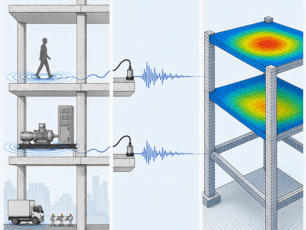
Vibration analysis is the process of understanding how much a floor, structure, room or piece of equipment moves when it is affected by things like footfall, machinery, traffic or ground movement. It helps engineers predict how a space is likely to respond and determine whether that movement is acceptable for comfort, function or performance.
In MRI suites, laboratories and other vibration sensitive environments, even small movements can have outsized consequences. If performance is not properly resolved early, the result can be operational risk, reduced efficiency, or costly corrective work later in the project.
Rigorous vibration analysis gives engineers a stronger basis for design decisions, helping avoid overconservative assumptions and better inform elements such as slab design.
Why generic checks can fall short
Standard methods can fall short because not every analytical approach is suited to the subtle, everyday vibrations that affect controlled environments. Response-spectrum methods, for example, are principally associated with seismic analysis, while vibration-sensitive spaces can require a more detailed understanding of how floors respond to everyday excitation. They also often rely on simplified response factors that reduce behaviour to a single broad measure. In spaces such as MRI suites, laboratories and clinics, that level of abstraction can miss important nuances, making a more tailored, project specific assessment necessary.
No building behaves in exactly the same way. Footfall, acoustic transfer, equipment sensitivity and external disturbance can all influence performance differently depending on the space and its intended use. Broad checks have their place, but they may not fully capture how a sensitive environment will respond under everyday operating conditions.
A more tailored approach goes beyond generic guideline checks to understand how a floor or structure is likely to behave in its actual use case. It can combine on site instrumentation such as accelerometers, mathematical analysis of floor accelerations, finite element modelling, and custom in-house scripts developed to interrogate building response in greater detail.
Robert Bird Group combines technical expertise, data led analysis and advanced modelling to assess vibration performance with greater precision. By accounting for factors such as footfall, equipment sensitivity and acoustic isolation, the team can shape the structure around the performance demands of the space.
How analysis shapes design
Project specific vibration analysis can directly influence slab design, structural tuning and isolation strategies, giving teams greater confidence that a space will perform as intended. Its value is greatest in environments where control matters, including clinics, MRI suites, laboratories, life sciences facilities, offices with vibration sensitive equipment and industrial premises.
By understanding how a structure is likely to respond in real use, engineers can design with greater precision, reduce the risk of performance issues emerging later, and make more informed decisions from the outset. Applied across live projects, these tools help analyse floor accelerations, compare scenarios and test project specific criteria, building a clearer picture of how a space is likely to behave in use.
In Australia, clients like Kurraba have benefited from this approach because it provides a more detailed understanding of how sensitive spaces are likely to perform in use, supporting better informed structural decisions from the outset.
In other cases, the need has emerged after construction. In the UK, Robert Bird Group has assisted a prominent event venue seeking to better understand vibration impacts on neighbouring spaces. Although the original design had followed the relevant codes, nuances in building performance led to unintended disturbance beyond the immediate structure. In this instance, the team helped identify how vibration was transferring through the building and supported a solution that curbed disturbance while reducing the risk of costly retrofit or redesign.
Designing for performance in practice
The value of project-specific vibration analysis is in designing to how a space will actually be used. Moving beyond broad assumptions can reduce unnecessary overdesign and help manage performance risk, giving teams a stronger evidence base for structural decisions and greater confidence in how the finished space will perform.